- English

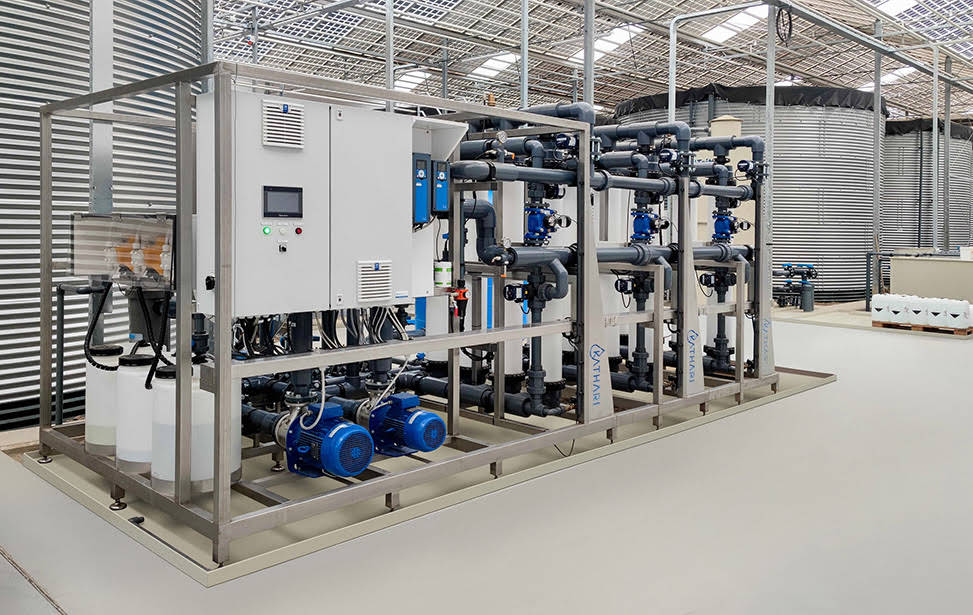
By correctly reusing drain water, a grower can significantly save on valuable nutrients and water. However, since drain water can contain pathogens, treatment of the drain water is essential. With the application of Kathari, the crop is optimally protected against Nematode* (roundworms or nematodes), bacteria, and viruses with a high removal certainty and at low operational costs.
Kathari ** achieves high LOG reductions through the application of ultrafiltration (UF). Ultrafiltration is a pressure-driven membrane process that achieves a filtration fineness of 20 nanometers. Due to UF being an energy-efficient and chemical-free technique, this happens in a cost-effective manner. So, it’s a win-win situation. The operation of ultrafiltration focuses on the physical removal of pathogens, unlike the most common applications that mainly focus on destruction. UF is a process that uses water pressure and membranes to separate different substances from each other. The membranes allow water, ions, and molecules to pass through while viruses, bacteria, fungi, and suspended solids are retained and removed. Therefore, it is an excellent technique for purifying water and also enables the reuse of water and nutrients. The UF technique has been a proven method for decades and is used worldwide in water treatment situations. Van der Ende Group has further optimized this technique for use in horticulture and has already implemented it in about 30 different countries.
Meloidogyne enterolobii, also known as the guava root-knot nematode or the root-knot nematode, is a plant-parasitic nematode belonging to the genus Meloidogyne. It is an aggressive and harmful species known worldwide for its ability to infect a wide range of plants. Infection by Meloidogyne enterolobii occurs when the juvenile nematodes penetrate the roots of the host plant. They cause the formation of nodules or galls on the roots, which leads to damage to the root system and disruption of the plant’s nutrient uptake. This often results in reduced growth, lower yields, and increased susceptibility to other diseases.
** Kathari has been tested for the removal of the brown rot virus by two independent institutes. Entry of the brown rot virus occurs through the wounds and stomata of a plant, after which the brown rot bacterium moves to the xylem vessels. The wounds are often caused by root-knot nematodes, which exert a parasitic effect on the plants (source: Brinkman).