- English

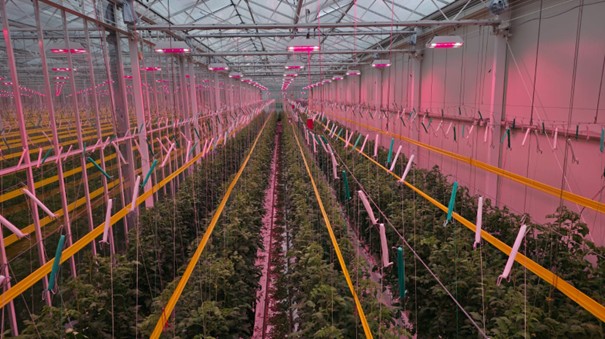
Food Autonomy Lighting’s research team conducted a trial with the renowned Dutch research institute, Plant Lighting B.V., to explore how LEDFan technology influences greenhouse climates.
The results?
LEDFan enhances heat exchange , increases crop transpiration, which may improve nutrient uptake.
“During this trial, LEDFan fan effects were most present directly below the lighting fixtures. The combination of elevated air temperature, decreased relative humidity , and increased air movement points to an increase in crop transpiration, a key driver for plant health and growth!” – Martijn Wiekens
Introduction
In greenhouse horticulture, climate conditions such as temperature distribution, humidity, and air movement play a crucial role in plant health, nutrient uptake, and overall crop performance.
Food Autonomy, in collaboration with Plant Lighting as an independent research advisor, conducted a pilot study in a greenhouse in the Netherlands to assess the effects of LEDFan technology on greenhouse climate and high-wire tomato cultivation.
LEDFan integrates LED lighting with an active ventilation system, moving air through the fixture to promote heat exchange and better airflow distribution. The goal of this study was to determine how LEDFan influences temperature regulation, humidity levels, transpiration rates, and potential energy efficiency.
Project Scope & Objectives
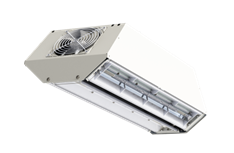
The study was conducted in a 500 m² greenhouse compartment with a fully grown high-wire tomato canopy. The LEDFan system alternated between “on” and “off” every three days simulating standard LED without active cooling to allow for comparisons of LEDFan’s effects.
The fixtures were switched on between 00:00 to 5:00 pm. The beneficial LEDFan effect was most visible between 00:00 and 9:00 am.
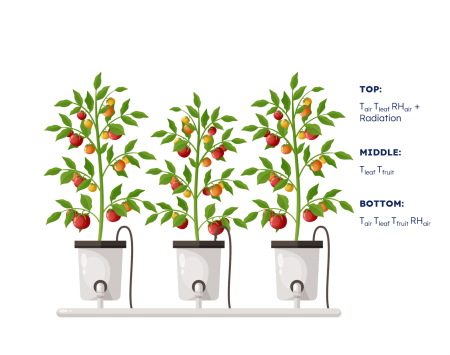
Measurements were taken at two key locations and at three different heights of the canopy:
Key Findings & Observations
The study revealed that LEDFan had a significant localized effect, particularly directly below the fixtures. With the fans on:
“One strategy to potentially alleviate the microclimate heterogeneity, is the use of fan technology. Fans can alter the movement and distribution of air, enhancing air mixing and potentially improving the homogeneity of the greenhouse climate and the leaf and fruit temperature. Normally, warmer air typically accumulates near the top of the greenhouse, below the greenhouse roof or screens. Through enhanced air movement this (vertical) temperature gradient is potentially decreased.” – Martijn Wiekens, researcher at Plant Lighting.
Transpiration has a crucial role in plant health, as it facilitates nutrient uptake from the root system.
Using LEDFan, we achieved lower relative humidity at the canopy level, which can be a driving factor for crop transpiration. With LEDFan’s airflow enhancing transpiration, plants may be able to absorb nutrients more effectively, potentially mitigating some of the challenges growers face with LED lighting.
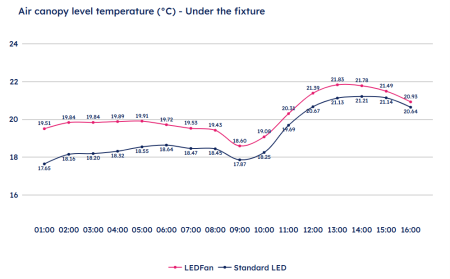
“The combination of elevated air temperature decreased relative humidity, assumably more wind-speed and no changes in leaf temperature at canopy level with the fans of the LEDFan on, points to an increase in crop transpiration. Increased crop transpiration can lead to an increase in nutrient uptake. If this localized effect right below the fixture can be spread out over a larger area, it may enable growing more successfully under LED-lighting.” – says Martijn Wiekens, researcher.
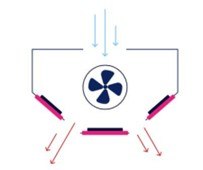
The LEDFan technology contributed to better air movement within the greenhouse, helping to reduce vertical temperature differences.
Warm air, which normally accumulates near the roof, was redirected towards the canopy.
If this effect can be extended across a larger area and time frame, it could help homogenize the greenhouse climate, reducing temperature fluctuations and improving growing conditions.
One of the most promising observations was a decrease in heating pipe temperatures when the LEDFan system was active.
This suggests that LEDFan may contribute to reducing overall heating demand in greenhouses.
Conclusion
This pilot study demonstrated that LEDFan technology influences greenhouse microclimates and has a potential to optimise greenhouse cultivation technology, particularly by enhancing airflow, increasing canopy temperature, decreasing relative humidity level,, resulting in lower heating demands. Addressing common challenges, these effects could help optimize tomato production under LED lighting.
By integrating lighting and airflow management, LEDFan has the potential to redefine controlled-environment horticulture, making year-round greenhouse production more efficient and sustainable.